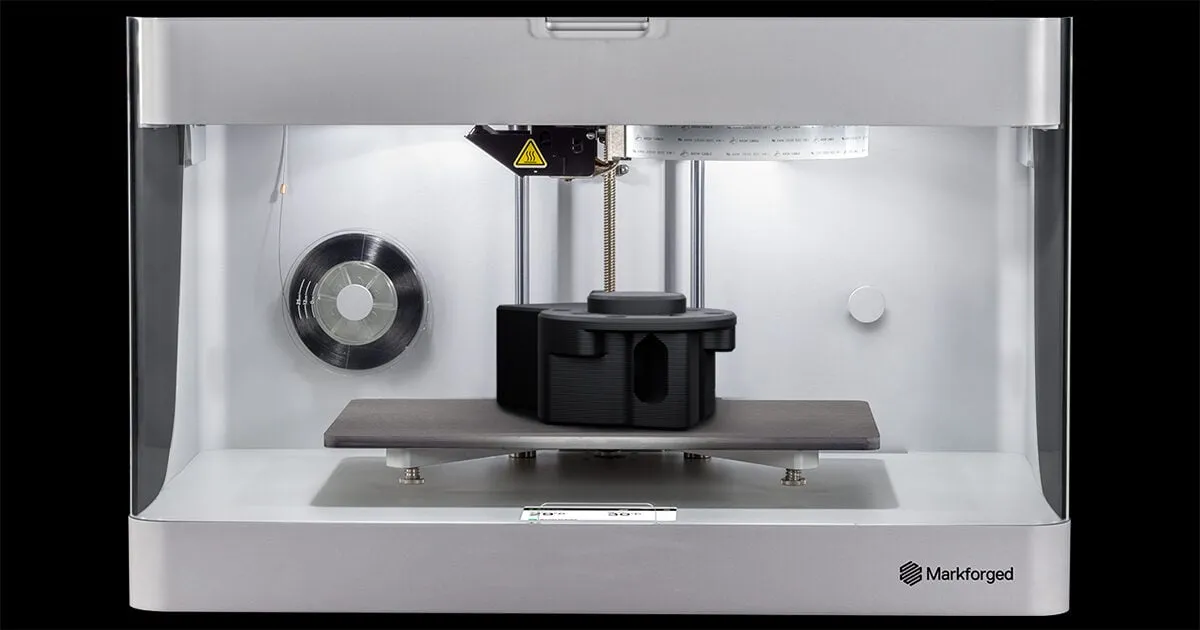
Markforged Mark Two
Artiklarna är skrivna på engelska.
Av
Christian Magnusson
VD och ägare
Markforged, the Boston-based manufacturer of 3D printing systems, is one of the leading additive manufacturing companies in the world today. It offers a range of metal and carbon-fiber 3D printers for both desktop and industrial usage. Additionally it also offers a professional-quality cloud slicer software – Eiger.
In this article we review the company and one of its most popular offerings – Markforged Mark Two, a carbon-fiber 3D printer equipped with Eiger software.
Markforged
Firstly, let's talk about the company. Markforged was founded in 2013 by Greg Mark, an aerospace engineer and three-time entrepreneur. The vision of the founder was to build a robust additive manufacturing solution that could change the world. Over the years the company has acquired numerous patents for its novel system that have resulted in increasing manufacturing system efficiency for its customers. The system also offered better and faster ways of making functional prototypes, tools and fixtures, and end use parts—at scale.
Markforged has raised multiple funding rounds from reputed PE investment firms like Summit Partners, Next47 (Siemens), Porsche SE, Matrix Partners, and others.
Markforged Mark Two
Markforged Mark Two is a desktop carbon-fiber 3D printer equipped with its proprietary slicer software – the Eiger Software. We will now look at all the aspects of the printer in detail.
The 3D printer
Mark Two, as mentioned earlier, is a professional-quality carbon-fiber 3D printer allowing for more printing options in terms of materials.
Mark Two is a desktop 3D printer with an aluminum body and a lid on top that lifts for easy access to the extruder assembly while loading materials. It has a build volume of 320 mm x 132 mm x 154 mm. It offers a sharp 100 micron resolution. The printer also has a built-in touchscreen interface that makes it easy to connect to Wi-Fi, start prints and manage the printer.
The printer comes with a multitude of accessories like dry box, 800cc Onyx spool, 100cc Carbon Fiber, 50cc Fiberglass, 50cc Kevlar, 50cc HSHT Fiberglass, 1 TrueBed print bed and access to cloud Eiger software.
Mark Two doesn't provide auto-bed levelling; instead it sports smart lever-style adjustment points which simplify the bed levelling. The bed-levelling wizard runs twice over these points and makes sure the bed is properly levelled. Once the wizard is successful, the bed can be removed and re-installed any number of times and it just snaps back into place every single time.
The 3D printer is competitively priced at $13,500 (excluding taxes).
Materials
The Mark Two prints with plastic as well as with multiple fiber materials. It can print with Carbon Fiber, Fiberglass, Kevlar, & HSHT Fiberglass (High-Strength High-Temperature Fiberglass). In essence, the printer prints with high-performance Nylon material reinforced with fiber. This gives the material greater strength, so it can replace metal in some cases.
The base material – Onyx – is already very strong and offers great print quality. The material is a bit less rigid and a bit more ductile than regular 3D printing materials. But the addition of fiber can drastically improve the mechanical properties of the part. By controlling the amount of fiber infused in the part, the strength of the part can be made comparable to parts machined from solid aluminum.
The software
The Markforged line of 3D printers is restricted to its proprietary Eiger software. The printer offers multiple connectivity options like Ethernet, USB, & WiFi and all these integrate really well with the Eiger software.
Eiger is cloud-based software that runs in any browser (preferably Chrome), where the STL files are uploaded. Once uploaded the software takes over, performs all necessary checks and suggests print settings based on the part's geometry, such as infill ratios or extra support material. This reduces the extra leg work needed to get the printing right and thus saves the user time and effort.
Apart from the settings, the software also lets the user control the use and amount of continuous fiber in the print.
Eiger also supports versioning of your parts and print settings. If the user doesn't like the 100% web-based approach, they can leave the printer offline and use USB drives for print files and firmware updates, or optionally get an offline version of Eiger. There's no support for alternative software and slicers, but the print files do look like a standard g-code file with a very simple compression.
Salient features
- High-strength printing: Since the material is reinforced with composite fiber while 3D printing, the Mark Two achieves unparalleled strength, stiffness and durability in its printed parts.
- Easy to use: The Mark Two makes up for a fine combination of machine and software. Both complement each other well and provide fantastic printing results.
- Range of materials: In addition to printing Onyx, the Mark Two uses materials that few other desktop 3D printers can print with, like Carbon Fiber, Fiberglass and Kevlar.
- Professional software: Eiger is high-quality cloud software for slicing along with controlling other essential parameters.
3D printing services
Industries around the world are shifting some of their product manufacturing from traditional processes to additive processes. But the journey can have a rather big learning curve. It is always recommended that companies first seek expert guidance and learn more about the printing systems.
For such guidance in Sweden, companies can approach professional consultant Stefan Hofflander. Stefan runs his own design and manufacturing consulting firm, Hofflander Group AB. His firm consults in Finite Element Analysis, CAD design (specifically Catia and SolidWorks), engineering design and additive manufacturing. The firm also operates a Mark Two 3D printer and helps companies adopt 3D printing by offering guidance and feasibility studies, such as identifying which products to 3D print and which to keep manufacturing through traditional processes.